What now? I really want to show you with a practical, hands-on session that should feel a bit like being in a writers’ room. I’ll be running it. It’s going to be great fun. I hope you can join me! It’s at 6pm on Tuesday 26th April. Find out more HERE.
In the session, we’re going to be answering a couple of key questions that you need to think about when you’re trying to kick start your sitcom and writing that pilot script.
The first question is this:
What’s the sitcom about?
Sure, it’s about some funny people who work in a shop that sells cards, gifts and party things. It’s called Big Day! (It’s a sitcom I’ve created for training purposes.) It’s a shop in a shopping mall that has you covered when it comes to special occasions for those special people.
But what’s it REALLY about?
It’s the about the characters, right? Yes, kind of. There’s Ruby, Bill, Geraldine, Amy, Donna and Wayne, who runs the coffee stand opposite.
But what’s at the heart of the show?
We need some clear idea about why we’re writing about these characters in this situation now. It’s not just about the business of selling birthday cards. Or is it?
What's the solution? How do we kick start the sitcom? Find out over HERE where there's more information about the webinar and you can sign up. It’s pay-what-you-like, mainly so I can keep track of space in the Zoom room.
Sign up here and you’ll be sent the situation and details of the characters plus a bit of homework to do in advance, and then in the webinar, you can pitch an idea either verbally or in the chat. And we’ll see what we end up with! I have no idea how this is show’s going to turn out and I can’t wait to find out. I really hope you can join me.
In the first two articles in the series I really laboured why your script should not involve your lead character turning up to their first day at work, the main reasons being:
#1: It is a very common plot in pilot scripts #2: Your main character is going to be reactive or passive #3: ALL of your other characters are going to be funnier than your (passive) LEAD character.
I had a sample sitcom in which Deborah turned up on her first day, and being introduced to Alice, Jake, Megan, Val and Clem who all seemed funnier than Deborah.
Why is that?
Because Alice, Jake, Megan, Val and Clem have already started.
As far as we’re concerned, we arrive in the middle of their story. They’re settled into the office being themselves, embroiled in rivalries, plots, shenigans and stories. That’s when they’re funny.
And that’s the really big sitcom lesson to learn here: start in the middle.
Don't start at the beginning which is a terrible place to start. (Thanks, Maria.) Start in the middle.
If we want Deborah to be as funny as the other characters, we need to start her off in the middle, not the beginning. Let’s have her already entrenched in office politics like her colleagues, not tentatively dipping her toe in.
We started in the middle of the other characters plots – Jake with his photocopier, Alice and her sister’s wedding dress, Megan and Val’s plant war and Clem’s trip to Hawaii. They’ve all hit the ground running. Why aren’t we doing that with Deborah? Especially if she’s going to be the main character.
The fact is you can have character arriving on their first day, but it probably shouldn’t be the lead protagonist.
In Bluestone 42, we started the show with the bomb disposal team doing its thing, led by Captain Nick Medhurst who is the focal point of the show. Once they’ve done their thing, found the bomb and blown up the baddies, Nick gets back and meets a character who is new to the base. The padre, Mary. And he takes this as a chance to show off. And we can see that she’s met people like him before and isn’t that impressed.
We did start with another ‘new character’ in Bluestone 42, a visitor from the CIA played by Mike McShane.
Reader, we shot him.
This was to demonstrate that this was active war zone and that if didn’t follow procedures, you would die. So we now know what the stakes are in this sitcom world.
But you might be thinking my sitcom’s not set in an a war zoom or an office so none of this applies to me.
Well, actually, it might.
Sample #1 Your protagonist, Laura, is buying into a new house next to a church yard, and the estate agent is showing them around one last time, and then the removal men are bringing in their possession. This conveyor belt of possessions may reveal a character but your character is still being passive for pages and pages.
Start the Laura show in the middle. They’ve moved in to the house and already discovered that it’s horribly haunted by the graveyard next door and they’re living with it.
Sample #2 Or your protagonist, Terry, isn’t on his first day at work, but his last. He’s been fired from his job as an engineer, and gets home to find his partner has left. And then his long lost daughter turns up pregnant and moves in. Again, that’s pages of stuff happening, but it’s happening to your character. They are passive.
Start the Terry show in the middle. He’s an out-of-work engineer-turned-inventor, living with his daughter who has a new baby to cope with.
Don’t start at the beginning. Start in the Middle.
This is one of many mistakes it's easy to make in a pilot sitcom script. Why not find out the most common 14 problems in your script, based on the experience of reading literally hundreds of scripts in the last year? And crucially, find out how to fix them. Find out more HERE.
You can either read this blog, or watch me explain the whole thing in SEVEN minutes - with some nice visuals and graphics - here:
Wanna read? Okay, here we go:
Last time, I was fairly robust about why your pilot script should not be the first day at work for your lead character. Why? Three reasons.
Reason #1 The First Day At Work plot is a grindingly common tactic in a pilot script. Your script needs to stand out amongst the thousands of other pilot sitcom scripts floating around.
Reason #2 Your character is going to be acting out of character on their first day, being on their best behaviour. We need to establish them fast.
Reason #3 And this is the most important, your lead character is going to be passive for at least the first ten pages. That’s a problem because that is when the script reader is making up their mind about the script. They need to be making choices, revealing character and being funny, rather than nodding and noting where the coffee machine is, and where the mugs are.
But here’s another reason to avoid a ‘first day at work’ pilot plot: all of your other characters are going to be funnier than your passive lead who’s wondering the office wondering what they’ve gotten themselves into.
Reason #4 Your Lead Character is the Least Funny Character in the Room
Let’s say your lead protagonist, Deborah, is being shown around the office on her first day.
Scene one is the obligatory pep talk to herself outside.
Scene two is at reception where she is polite to the receptionist, Alice, who is engrossed in a video chat with her sister who is trying to chose a wedding dress and not paying Deborah any attention.
Eventually, scene three, Alice passes Deborah on to Jake whom we find having a fight with the photocopier to the point of declaring war on it.
Then Deborah meets Megan and Val. They are having a long-running feud with each other over office plants, which is escalating to the point where one part of the office is now a jungle.
Next Deborah is surprised that her boss, Clem, is trying different swimming costumes for their next conference which happens to be in Hawaii.
It’s Page Ten. Deborah has done nothing but react. She is passive.
And who’s the funniest character so far?
Answer: NOT DEBORAH. Deborah is booooring.
So we’re off to a terrible start.
Alice, Jake, Megan, Val and Clem already sound funnier than the lead character who’s nervously greeting people on their first day. That’s a problem.
Taking Action
As a script editor or development producer, I’m looking at this pilot script saying ‘this could work if you just get rid of Deborah’. I like Alice, Jake, Megan, Val and Clem. Lose Deborah.
You might have one of two replies to that:
Reply #1 You say, “Yeah. Wow. Deborah is boring. I guess she was useful to begin with, but actually she’s not necessary”. Great.
Solution #1 Deborah deleted. Script gets rewritten and we’re into it.
Reply #2 You say, “But the WHOLE show is about Deborah and her journey!”
We have a problem. One is existential one about what a sitcom actually is (it’s not about Deborah’s journey but we’ll get to that in a future post).
But the main issue here is a comic problem. This ‘first day’ storyline is essentially preventing Deborah from being active and funny.
Solution #2a Your solution might to have Deborah apply for that job and make her more active.
NO. WRONG.
The solution even worse than the problem. We’re going backwards. Your character needs to pointing forward. What do they want? What is their goal?
Solution #2b Fast forward. Deborah’s been there six months. Or it’s her first anniversary of being there.
Solution #2c Even better, just have a regular episode based on her character and situation. Jake’s plotting the demise of the photographer. Megan and Val have some kind of foliage/turf war going on. And Deborah is concerned that her boss’s trip to Hawaii is going to be a huge problem for her – and she has to put them off going. Clear goal. Stop boss going to Hawaii.
Next time, we’ll consider why Alice, Jake, Megan, Val and Clem sound funnier than Deborah, and what we can learn from that.
This is one of many mistakes it's easy to make in a pilot sitcom script. Why not find out the most common 14 problems, based on the experience of reading literally hundreds of scripts in the last year? And crucially, find out how to fix them. Have a look HERE.
“Let’s start at the very beginning, a very good place to start…”
That’s how Maria (Julie Andrews) starts her Do-Re-Mi song. If you’re writing a pilot sitcom script, what could be a better way to introduce the audience to the characters than following around the main character on their first day at work? Sounds sensible. Right?
Wrong.
As far as writing a sitcom is concerned, it’s terrible advice. Do me a favour, Maria. Take your guitar and climb a mountain. So long. Farewell.
Do I sound a little tetchy on this?
It’s because since the beginning of this year, I have read over three thousand pages of sitcom script and this ‘first day at work’ plot is a very common feature to many, probably most, of these scripts that haven’t been picked up or shortlisted.
First Day At Work
It’s their first day. They’re nervously standing around outside giving themselves a pep talk before stepping into their new place of work.
Or, worse, we start with a ringing alarm on a bedside table, and a character floundering around getting ready for their first day, shouting at their partner, or their kids, kicking the cat and then running out so as not to be late on their first day.
Or worse still. They’re applying for a job (at which they get to explain their backstory). Then they get the job, and then it’s their first day.
Why am I taking exception to this whole ‘first day’ thing? Why is this a problem?
One might think one reason is that if everyone else is doing this, then you should do something else. March to the beat of a different drum. Be the odd one out. Zig while the world is zagging. After all, we had 887 scripts for our Sitcom Geeks Hattrick competition.
That’s true enough. When a huge number of scripts are starting the same way, the reader of the script – who is a human being, remember – is going to groan.
But the reason not to start your script with the protagonist turning up to work on their first day is this: your protagonist is going to be passive. This is a serious problem.
In a sitcom, we need to see the hero making choices. In fact, that’s not unique to sitcom. That’s drama. That’s novels. That’s movies. That is how character is revealed, through choices which bring chaos and conflict, and with a bit of luck, a following wind and several rewrites, a chance of comedy.
Being Nice
How were you on your first day at work?
I’ll tell you. You were on your best behaviour. You were not yourself.
Unless your protagonist a maniac or psychopath, they’re going to be terribly nice to everyone while they are guided from room to room, being introduced to other members of the team. We’re not going to find out what they’re really like for ages. The reader needs to know what the character is like because she’s got a hundred other scripts to read. The viewer needs to know that because he’s got serious options when it comes to alternatives to your show.
So my advice – having read 3000+ pages of sitcoms in the last two months - would be this: Avoid pilot sitcoms script where it’s the main character’s first day.
Now, you might be screaming names of sitcoms which do exactly that. Fine. We might get to those. And I’ve written two sitcoms where it’s a character's first day (Bluestone 42 & Hut 33), but I’m going to justify those in a future post.
But for now, why not join my mailing list, The Situation Room? You'll get all kinds of help writing your pilot sitcom script, including access to free videos about Plotting, Creating Characters and all sorts. It's free. Join here.
I've been very quiet recently. Plenty is brewing. I've been reading literally hundreds of pilot sitcom scrips for the Sitcom Geeks Hat Trick competition and I have many many things to say as a result.
I'll be saying them here, and on my Situation Room YouTube channel, and producing all manner of resources throughout 2022.
To find out about them, join my Situation Room Mailing List - where you'll also find bonus free videos about Plotting, Character and Comedy Drama. And there are discounts and priority booking to the courses and webinars I'll be running to help you write better sitcom scripts.
Sign up and you get an email in your inbox, rather than having to scroll through the rage and fury ofTwitter or Facebook for reminders or updates. So why not give it a go? Subscribe here.
There's not been a blog all year. And here’s the main reason I’ve been quiet: I’ve been reading scripts.
Loads of them. Hundreds. Thousands! Actually, not thousands. But nearly a thousand.
We ran a competition on the Sitcom Geeks podcast in conjunction with Hat Trick Productions and we received 887 entries. That's 887 pilot sitcom scripts. The winner should be announced soon.
So what did I learn reading hundreds of pilot sitcom scripts?
It has been very revealing to read what newer writers are interested in writing about, and how they go about it. And I have to be honest. It’s been very frustrating. Why?
The vast majority of scripts are making basic mistakes so that by the time I’ve read to page ten, I’ve made up my mind to move on to the next script. And it's painful when I know how much work has gone into the script I'm reading.
So here's the big question:
How can you avoid making those mistakes?
I plan to spend the rest of this year telling you on this blog and on YouTube. They will be dropping regularly throughout the year. So look out for those. If you want to be kept informed of all that stuff, join The Situation Room mailing list for free. Straight away you'll get access to some videos and webinars that aren't on YouTube. Including videos on Creating Sitcom Characters, Plotting Your Sitcom and 13 Rules of Sitcom.
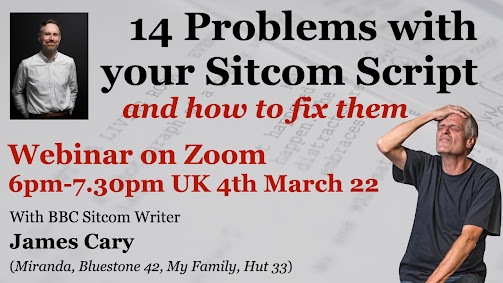
But you'll have also found out about this Webinar I'm running on Friday March 4th called 14 Problems with your Sitcom Script. And I'm doing it because I think I know what writers really want:
What Writers Want (apart from money and coffee)
Here’s what: notes. Feedback! If not unalloyed praise, then at least constructive criticism. Writers want some indication of where they are going wrong in their scripts so they can improve.
In the case of the competition, we’re unable to give feedback on every script. There are just too many. So, heads up. In a month or so, I’m going to be announcing a Supercharged Script Reading Service.
But in advance of that, and at a much lower price, I’m releasing a resource called 14 Problems With Your Sitcom Script. It’s a 50+ page script diagnosis, explaining how most pilot sitcom scripts are going wrong and, crucially, how to remedy these avoidable problems.
That Webinar
And I’m hosting a webinar for that at 6pm-7.30pm on Friday 4th Marchon Zoom when I will run through the 14 Problems most common in the sitcom scripts I read.
Which will apply to yours? Do come and find out. There’ll also be lots of chances to ask me questions.
There is a small charge for that webinar (£17.99). These resources take a lot of time to get written, and get right – but the webinar will include a free copy of the PDF (which will cost £27 from Sat 5th March onwards so worth signing up just for that early bird price).
I don’t quote Jesus much on this blog, and I’ll have to be honest and say he was not referring to writing sitcoms when he said this:
“For which of you, desiring to build a tower, does not first sit down and count the cost, whether he has enough to complete it? Otherwise, when he has laid a foundation and is not able to finish, all who see it begin to mock him, saying, ‘This man began to build and was not able to finish.’
"Or what king, going out to encounter another king in war, will not sit down first and deliberate whether he is able with ten thousand to meet him who comes against him with twenty thousand? And if not, while the other is yet a great way off, he sends a delegation and asks for terms of peace." (Luke 14:28-32)
And so in the Gospel According to Sitcom Geek I say unto thee:
“Which of you, wanting to write a spec sitcom script will not find out when the deadline is, and figure out how long it will take to hit that deadline with a good script and work the process back from there? Otherwise the script sent in will be bobbins and there will be much wailing and gnashing of teeth that this was another opportunity missed.”
You get the idea.
A spec sitcom script is a really hard document to write. The hardest. I explain why HERE.
So what the answer? As I explain in the video below, a really common problem is that people rush to start writing the script.
Don’t rush into the script
If you don’t have a solid idea that makes the most of your voice and perspective, with characters embody that idea, you don’t have a sitcom. Not yet. But you could. And you need to allow time for that.
If you have some characters you’ll need some plots that embody that the fundamental idea of the show, which put your characters into difficult, stressful situations and in conflict with other characters. And that will be funny. But which plot should you go with?
The problem I often see in spec pilot scripts is the story of the episode is the set up. As my podcast co-host, Dave Cohen says, it’s a confusion of Plot and Premise.
Premises, Premises
The Premise of the show is the situation, the person in the place.
Ted Lasso is a relentlessly positive sports manager dropped into coach a Premiership soccer team.
A young couple inherit a house that is full of ghosts that only one of them can see.
A snob with a short fuse is running a hotel called Fawlty Towers.
A man lives out his action movie/Die Hard fantasies as an actual cop in Brooklyn.
That’s the premise: the character and the situation combined.
What's the Plot?
The plot is what the characters do in the premise.
The plot is the story of the week with a beginning, a middle and an end. It’s one way in which that cop lives our his Die Hard fantasy on the 99 Precinct. And there'll be a different way next time.
It’s one way in which the frustrated hotelier is the victim of his own snobbery and short temper. And there'll be a different way next time.
Lots of spec pilot scripts are all set-up. All premise. No plot. Maybe even most specs are like this.
This often involves establishing places we’re not returning to and characters we never see again. Crucially, they don’t give any sense of what the sitcom is actually going to be like each week.
Don’t Start in Iceland
If your sitcom is about an Icelandic chef hitting the big time as a celebrity chef in Paris, and your first episode is entirely in Iceland and she gets on a plane for France at the end of the episode, we still don’t really know what the sitcom’s actually going to be.
Start the show in Paris!
Let's see her cooking. Cheffing. Whatever chef's do.
We can have wistful flashbacks to her homeland in episode four or five, but give me a sense of what the sitcom is.
Sidenote: I think we’re only interested in origin stories once we’re hooked on the characters and the situation and the world.
The Premise Pilot Problem
The problem is that some actual TV shows start with set up for a whole episode (eg Ted Lasso). But if you’re an established TV writer and they commission you ten episodes for their streaming services right out of the gate, you can mess things around, start in the wrong place, build things slowly and generally take advantage of your, well, advantage. (I would still advise against doing that, but we’ll talk about that another time)
But unless you're Phoebe Waller-Bridge or Ricky Gervais, the story of your spec sitcom script should not, ideally, be all set up. The plot is not the premise. It does need to explain things and welcome in the viewer, and carefully reveal characters and information, not be an origin story.
You probably know a bit about story, situations and character, and how scenes should work. So you don't need to start from scratch. (For that sort of thing, take a look at my video course, Writing Your Sitcom)
In my Sitcom Superchargedcourse, I talk about story and plots – and a bunch of other things.
I run through some highlights and what script readers and producers are looking for from a ‘spec’ pilot sitcom script. It might not be what you think. Then I give some concrete advice on how long each stage might take, and how to make sure you’ve got time to not just write the script, but rewrite and polish that script so that by the time you’re submitting it, you can honestly say that it’s the best you could do - and we avoid the wailing and gnashing of teeth of regret that another opportunity has been missed.
Sitcom Supercharged short and punchy, big on practical advice based on two decades of experience of writing, and the UK sitcom world. Find out more here.